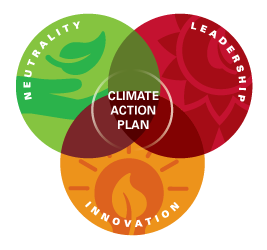
Several projects examine public views toward energy conservation and different energy technologies. Some of this research involves collaboration with faculty and staff at Cornell, which seeks to reach its carbon neutrality “net zero” goal by 2035. Other research examines public views about the acceptability of trade-offs associated with renewable energy technologies.
Community Engagement for Renewable Energy Developers
Efforts to develop diverse renewable energy portfolios will stall or fail if inadequate attention is given to community engagement in these transitions. We have extensive knowledge of best practices in community engagement, supported by robust literature and decades of practitioner experience. However, there remains a gap between these best practices and their adoption by developers. This project brings together a team of scholars and practitioners to strategically navigate these gaps and identify pathways to greater utilization of these best practices in New York State. We will update this site with the products of this project soon.
Enhanced Geothermal Systems and Deep Geothermal
A series of studies have delved into these questions in the context of geothermal energy development. Working in collaboration with researchers at University of Geneva in Switzerland, we used a cross-national survey to explore how perceptions of the deep underground impact reactions to deep geothermal and other subterranean processes in Europe and the US. Ongoing work with collaborators at the University of Edinburgh, Stirling University, and King’s College London as part of the “GEOHUB” project further explores these concepts and their implications for effective risk communication for renewable energy transitions and geothermal energy development.
Selected publications and presentations:
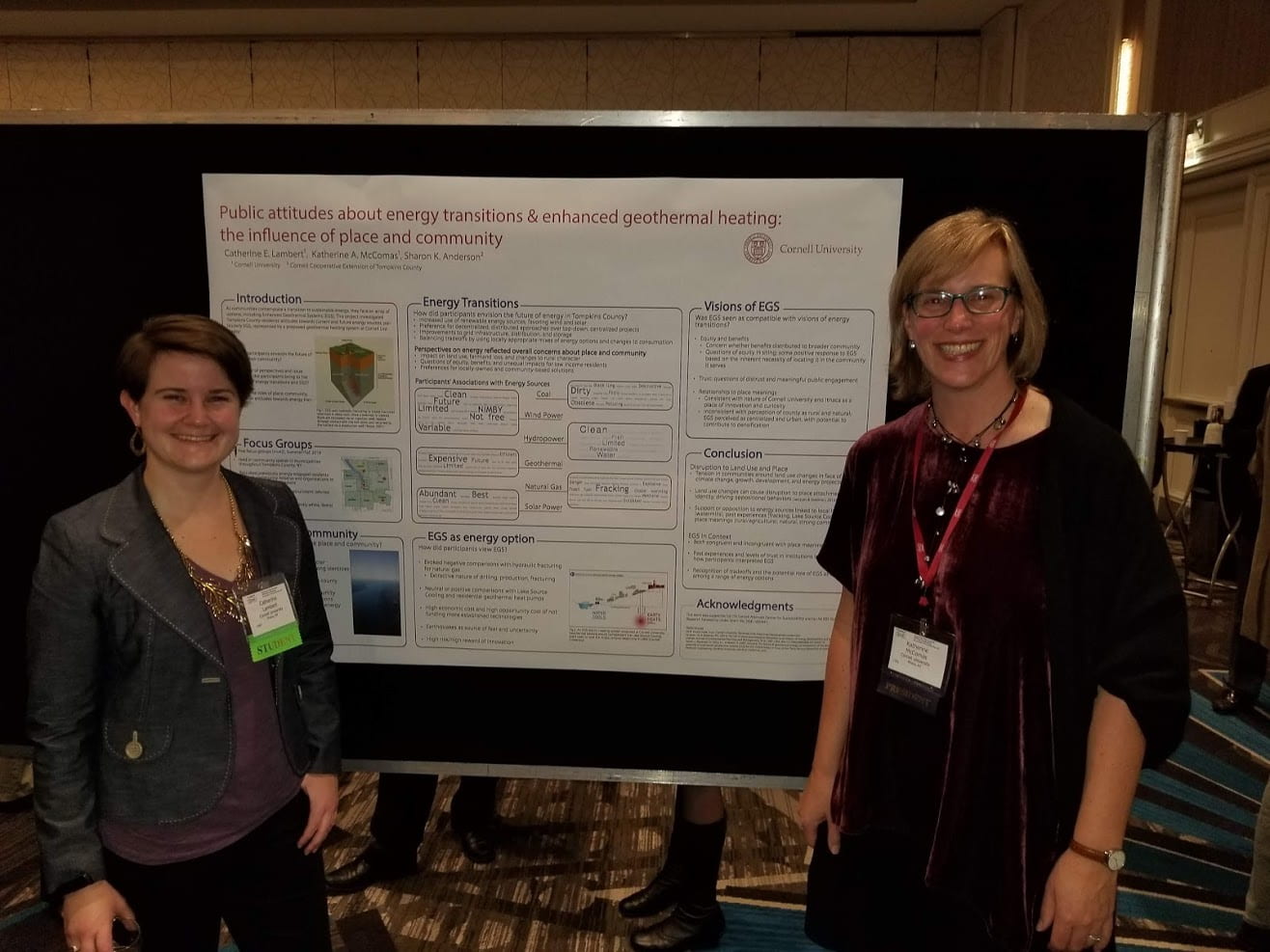
2019 SRA Annual Meeting
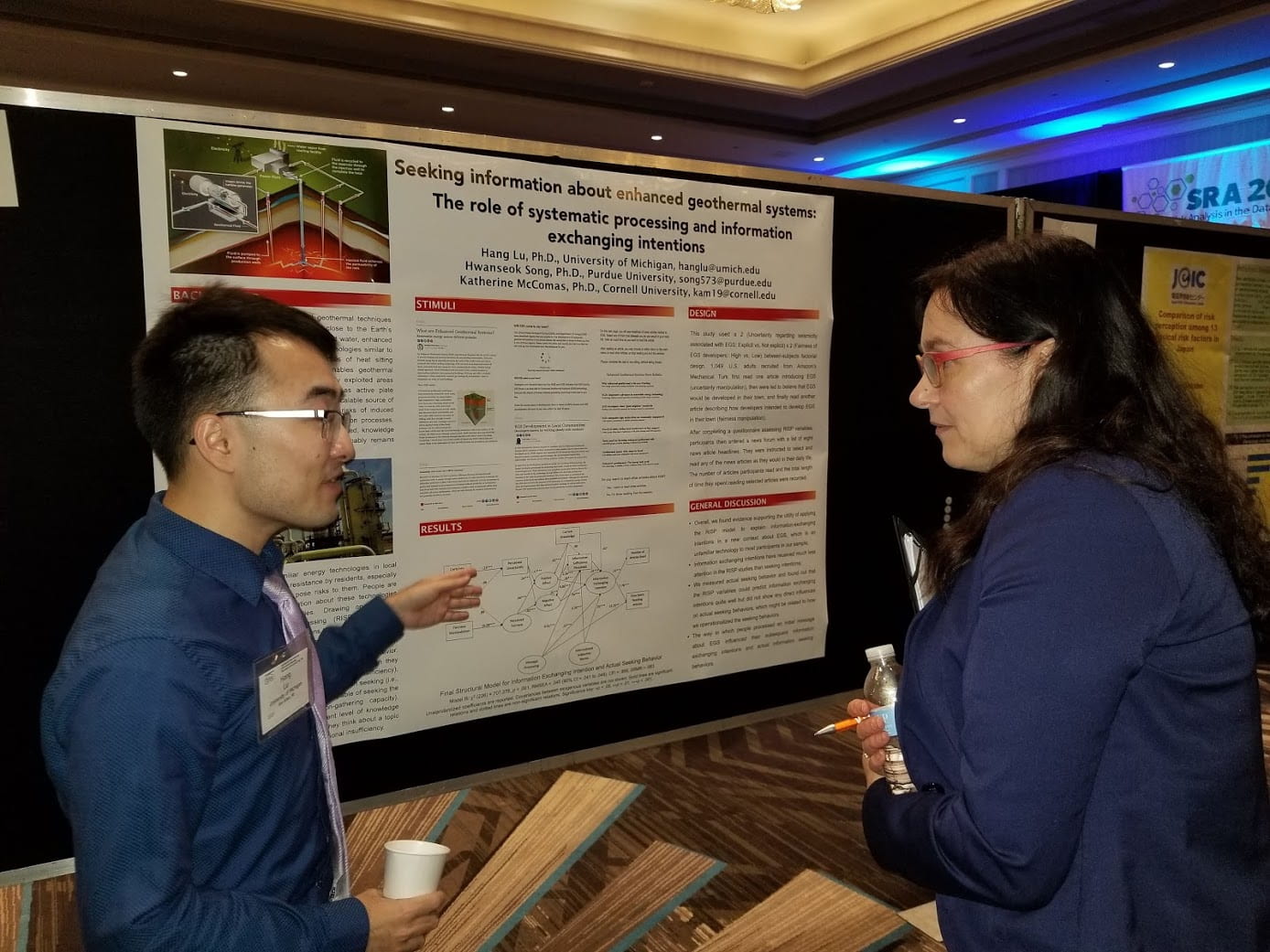
2019 SRA Annual Meeting
- Lambert, C.E. (2022). Beneath your feet and in your place: Multi-scalar imaginaries of energy, place, and local geothermal development. Energy Research & Social Science, Volume 94, 102856.
- Lu, H., Song, H., & McComas, K. A. (2021). Seeking information about enhanced geothermal systems: The role of fairness, uncertainty, systematic processing, and information engagement intentions. Renewable Energy, 169, 855-864.
- Song, H., Lu, H., & McComas, K.A. (2021). The role of fairness in early characterization of new technologies: Effects on selective exposure and risk perception. Risk Analysis, 41, 1614-1629.
- Lambert, C.E., McComas, K.A., & Anderson, S.K. (2019, December). Public attitudes about energy transitions and enhanced geothermal heating: the influence of place meaning, identity, and attachment. Presented at the Society for Risk Analysis Annual Meeting, Crystal City, VA.
- Abrahamse, W., Darby , S., & McComas, K. A. (2018). Communication Is Key: How to Discuss Energy and Environmental Issues with Consumers. IEEE Power and Energy Magazine. 16:29-34.
- McComas, K. A., Lu, H., Keranen, K., Furtney, M., & Song, H. (2016). Public perceptions and acceptance of induced earthquakes related to energy development. Energy Policy, 99, 27-32.
- Dixon, G., Deline, M., McComas, K. A., Chambliss, L., & Hoffmann, M. P. (2015). Saving Energy at the Workplace: The Salience of Behavioral Antecedents and Sense of Community. Energy Research & Social Science, 6,121 – 127.
- Hart, P., Stedman, R. C., & McComas, K. A. (2015). How physical proximity of climate mitigation projects influences the relationship between affect and public support. Journal of Environmental Psychology, 43,196 – 202.
- Besley, J., & McComas, K. (2014). Something old and something new: Comparing views about nanotechnology and nuclear energy. Journal of Risk Research.
- Dixon, G., McComas, K., Deline, M., Chambliss, L, & Hoffman, M. (2014). The use of comparative feedback to influence workplace energy conservation. Environment and Behavior.
- McComas, K., Stedman, R., & Hart, P. (2011). Community support for campus sustainability: The role of town-gown relationships. Energy Policy, 39, 2310 – 2318.